 |
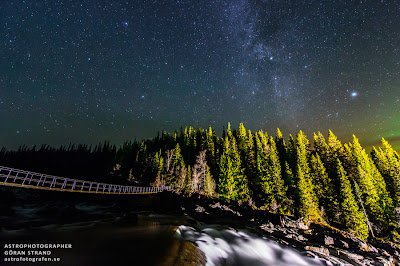
| Nikon D850 with Nikkor 14-24mm f/2.8 Exposure: 20 sec. ISO 1600 @ f/2.8 |

On my blog I share my passion for astrophotography and just about everything else that goes on in the sky, both day and night.
Showing posts with label milky way. Show all posts
Showing posts with label milky way. Show all posts
Thursday, April 19, 2018
The Milky Way and the Northern Lights
During this time of the year, the Milky Way stretches from North East to North West in the sky, perfect position to combine our galaxy with a faint Aurora. If the Aurora is to bright and active, it will block the light from the Milky Way. This panoramic photo I took last week is a perfect example of what a faint Aurora and the Milky Way looks like together.
Wednesday, October 11, 2017
Standing on the edge to the universe
Here's a mosaic image I've made from six shots taken on the 26th of September this year. With this projection of the sky I like the depth in the image and how the Milky Way with its reflections forms a complete circle in the image. The autumn is high season for shooting the Milky Way here in the northern hemisphere, so hopefully we'll get som more clear dark night ahead for more shots of the Milky Way.
Follow my work in social media
http://www.facebook.com/FotografGoranStrand
http://www.instagram.com/Astrofotografen
http://twitter.com/Astrofotografen
 |
| Nikon D850 with Nikon AF-S 14-24mm NiSi Natural Night Filter |
Follow my work in social media
http://www.facebook.com/FotografGoranStrand
http://www.instagram.com/Astrofotografen
http://twitter.com/Astrofotografen
Tuesday, April 18, 2017
Season finale
The dark season is ending and we're running out of darkness here in the northern hemisphere. This panoramic shot from last night shows a beautiful colored night sky filled with the Milky Way and the Northern Lights. As always I feel a bit sad that the stars is fading away for and I will miss nights like this during the summer. On the other hand, the bright summer nights is truly magic with their colors, they sure make a great substitute for the loss of the starry nights.
So this will most likely be my last Milky Way with Aurora shot for this season, but what a great finale it was! Se you on the other side Milky Way!
Click here to buy this photo as a print.
Follow my work in social media
http://www.facebook.com/FotografGoranStrand
http://www.instagram.com/Astrofotografen
http://twitter.com/Astrofotografen
So this will most likely be my last Milky Way with Aurora shot for this season, but what a great finale it was! Se you on the other side Milky Way!
Click here to buy this photo as a print.
 |
| Nikon D800E with Nikon AF-S 14-24 mm f/2.8 12 shot panorama with 20 sec. ISO 3200 at f/2.8 |
Follow my work in social media
http://www.facebook.com/FotografGoranStrand
http://www.instagram.com/Astrofotografen
http://twitter.com/Astrofotografen
Friday, January 6, 2017
Galaxies in the mountains
We're living on a small planet we call Earth. Our planet is located about two-thirds of the way out from the center of out home galaxy the Milky Way, that's about 26,000 light-years away from the center. In this photo you can see the Milky Way stretching up in the sky from behind the mountains.
Our closest neighboring galaxy is the Andromeda galaxy, it's located about 2,5 million light-years. It is the most distant object in the sky that you can see with your unaided eye. Here you can see Andromeda close to the center of the photo as a small disc shaped object. It apparent size in the sky is actually four times the size of a full Moon, but since its outer regions are so dim, we just see the much brighter center of the galaxy.
These two galaxies are actually on a collision course and will eventually merge together. But don't worry, it won’t happen for another 4 billion years. But just for a second, try to imagine what it will look like when Andromeda is much closer to us, that will really be some view.
The bright shining object down to the left is the Moon. At the time of this photo it was about 40% lit but since I used a long exposure time to expose for the Milky Way, the Moon is extremely over exposed.
This photo is a 7 shot panorama shot using a Nikon D810A with a Nikon AF-S 14-24 mm f/2.8 lens. Exposure for each photo was 20 seconds, ISO 1600 with f/4.0
Follow my work in social media
http://www.facebook.com/fotografgoranstrand
http://www.instagram.com/Astrofotografen
http://twitter.com/Astrofotografen
Our closest neighboring galaxy is the Andromeda galaxy, it's located about 2,5 million light-years. It is the most distant object in the sky that you can see with your unaided eye. Here you can see Andromeda close to the center of the photo as a small disc shaped object. It apparent size in the sky is actually four times the size of a full Moon, but since its outer regions are so dim, we just see the much brighter center of the galaxy.
These two galaxies are actually on a collision course and will eventually merge together. But don't worry, it won’t happen for another 4 billion years. But just for a second, try to imagine what it will look like when Andromeda is much closer to us, that will really be some view.
The bright shining object down to the left is the Moon. At the time of this photo it was about 40% lit but since I used a long exposure time to expose for the Milky Way, the Moon is extremely over exposed.
This photo is a 7 shot panorama shot using a Nikon D810A with a Nikon AF-S 14-24 mm f/2.8 lens. Exposure for each photo was 20 seconds, ISO 1600 with f/4.0
 |
| Two galaxies in the night sky |
Follow my work in social media
http://www.facebook.com/fotografgoranstrand
http://www.instagram.com/Astrofotografen
http://twitter.com/Astrofotografen
Saturday, December 10, 2016
Upcoming Geminid meteor shower
During one of my recent exposures of the Northern lights I caught this big meteor burning up in the atmosphere. Seeing these really bright meteors is always a joy and hopefully we'll see more of them now when we're closing in on the Geminid meteor shower that peaks on December 14th.

Follow my work in social media
http://www.facebook.com/fotografgoranstrand
http://www.instagram.com/Astrofotografen
http://twitter.com/Astrofotografen

Follow my work in social media
http://www.facebook.com/fotografgoranstrand
http://www.instagram.com/Astrofotografen
http://twitter.com/Astrofotografen
Tuesday, November 29, 2016
Looking back in time
When observing the night sky we're looking back in time. The light from the stars we see have traveled for many years before it reaches us here on Earth. In this photo of the Milky Way and an old church ruin, we can take a look in the past.
The big red nebula near the center is the North American Nebula. The light from this nebula had been traveling for about 1500 years before it reach my camera this night. As a comparison, the old ruin in the foreground is from a church that was build 900 years ago. When they started building that church in 1200 AD, the nebula light I caught on this night had done 60% of it's distance to Earth.
At the top of the image you can see the Andromeda galaxy as a small disc shaped object under the tree. The light from Andromeda has traveled for 2,5 billion years before it reach my camera. When that light started its journey, the first members of the genus Homo appeared on Earth.
It's quite mind blowing to think of this while standing under a starry night sky.
Follow my work in social media
http://www.facebook.com/fotografgoranstrand
http://www.instagram.com/Astrofotografen
http://twitter.com/Astrofotografen
The big red nebula near the center is the North American Nebula. The light from this nebula had been traveling for about 1500 years before it reach my camera this night. As a comparison, the old ruin in the foreground is from a church that was build 900 years ago. When they started building that church in 1200 AD, the nebula light I caught on this night had done 60% of it's distance to Earth.
At the top of the image you can see the Andromeda galaxy as a small disc shaped object under the tree. The light from Andromeda has traveled for 2,5 billion years before it reach my camera. When that light started its journey, the first members of the genus Homo appeared on Earth.
It's quite mind blowing to think of this while standing under a starry night sky.
 |
| Nikon D810A + Nikon 14-24mm f/2.8 @ 14 mm f/2.8 Exposure 20 sec. at ISO 3200 |
Follow my work in social media
http://www.facebook.com/fotografgoranstrand
http://www.instagram.com/Astrofotografen
http://twitter.com/Astrofotografen
Wednesday, October 26, 2016
Milky Way and small church
This is a three shot panorama of the Milky Way and a small church. Each shot is a 20 second exposure at ISO 1600, 14 mm f/2.8 with a Nikon D810A.

Follow my work in social media
http://www.facebook.com/fotografgoranstrand
http://www.instagram.com/Astrofotografen
http://twitter.com/Astrofotografen
Thursday, September 22, 2016
Milky Way photography close to a city
I often get asked if you need a really dark location to be able to see and shoot the Milky Way. My answer to that question is usually no, it all depends on the amount of light pollution in your area.
A couple of weeks ago I went to a location just 8 km from down town Östersund (A city with a population of 60,000 in the municipality). I could see the Milky Way with my naked eye as a faint band of stars stretching across the sky above our heads. In this photo down town Östersund is to the left just behind me and my friend. The bright light source by the horizon to the right is the setting Moon.
As for shooting the Milky Way you can see by this photo that some light pollution is OK as long as the Milky Way doesn't stretch through it. When editing the photos I was surprised on how low above the horizon the Milky Way was visible, despite being that close to the Moon.
The image below is a panorama made of 12 photos each shot with the same exposure settings, 20 sec. ISO 1600 using a Nikon D810A and a Nikon AF-S 14-24 mm f/2.8 lens at 14 mm f/2.8.
Follow my work in social media
http://www.facebook.com/fotografgoranstrand
http://www.instagram.com/Astrofotografen
http://twitter.com/Astrofotografen
A couple of weeks ago I went to a location just 8 km from down town Östersund (A city with a population of 60,000 in the municipality). I could see the Milky Way with my naked eye as a faint band of stars stretching across the sky above our heads. In this photo down town Östersund is to the left just behind me and my friend. The bright light source by the horizon to the right is the setting Moon.
As for shooting the Milky Way you can see by this photo that some light pollution is OK as long as the Milky Way doesn't stretch through it. When editing the photos I was surprised on how low above the horizon the Milky Way was visible, despite being that close to the Moon.
The image below is a panorama made of 12 photos each shot with the same exposure settings, 20 sec. ISO 1600 using a Nikon D810A and a Nikon AF-S 14-24 mm f/2.8 lens at 14 mm f/2.8.
 |
| The Milky Way over the city of Östersund |
Follow my work in social media
http://www.facebook.com/fotografgoranstrand
http://www.instagram.com/Astrofotografen
http://twitter.com/Astrofotografen
Tuesday, September 6, 2016
The Milky Way
Now that the astronomical nights are back I finally get to see and photograph the Milky Way again. When the darkness returns during the autumn, it feels like coming home from a long vacation when I can see the stars again.
This photo of the Milky Way was taken a couple of nights ago and is a four shot panorama using my Nikon D810A camera with a Nikon AF-S 14-24 mm f/2.8 lens at 20mm. Exposure was 20 seconds at ISO 3200 for each shot.

This photo of the Milky Way was taken a couple of nights ago and is a four shot panorama using my Nikon D810A camera with a Nikon AF-S 14-24 mm f/2.8 lens at 20mm. Exposure was 20 seconds at ISO 3200 for each shot.

Monday, September 7, 2015
Beneath the Milky Way
This weekend I was visiting one of my neighbors at their summer house. It's located in a really remote location with a wonderful dark sky. During the weekend I captured this image of their house beneath the Milky Way.
It's quite amazing to think that this little house is circling around in a giant galaxy filled with billions of stars.
It's quite amazing to think that this little house is circling around in a giant galaxy filled with billions of stars.
 |
| Nikon D810A, ISO 6400, 30 sec. 14 mm f/2.8 |
Tuesday, September 1, 2015
Astronomical nights arrives
Last night we experienced the first astronomical night here in Östersund, Sweden. Astronomical night is defined as when the geometric center of the sun is 18º or more below the horizon. Astronomical nights is something we astrophotographers want since then we can do really long exposures without the catching any light from the Sun.
September and October is also the high season for shooting the Milky Way. It's high in the sky and stretches over the entire sky from south west to north east around midnight.
Here's a shot I took a week ago when the sky still wasn't completely black. What you're seeing is our own galaxy The Milky Way rising from the horizon, filled with billion of stars, nebula's and interstellar dust blocking the light from distant stars creating these darker areas you're seeing.

Follow me on social media
https://www.facebook.com/fotografgoranstrand
https://instagram.com/astrofotografen
https://twitter.com/astrofotografen
September and October is also the high season for shooting the Milky Way. It's high in the sky and stretches over the entire sky from south west to north east around midnight.
Here's a shot I took a week ago when the sky still wasn't completely black. What you're seeing is our own galaxy The Milky Way rising from the horizon, filled with billion of stars, nebula's and interstellar dust blocking the light from distant stars creating these darker areas you're seeing.

Follow me on social media
https://www.facebook.com/fotografgoranstrand
https://instagram.com/astrofotografen
https://twitter.com/astrofotografen
Friday, April 17, 2015
Pink Aurora and the Milky Way
Lets celebrate the weekend with some pink and green aurora together with our galaxy the Milky Way, our neighboring galaxy Andromeda (Disc shaped object close to center), planet Venus (Bright dot to the left) and a satellite (Bright streak).
Follow me on Instagram - https://instagram.com/astrofotografen

Follow me on Instagram - https://instagram.com/astrofotografen
Friday, October 3, 2014
My Equinox Aurora - Astronomy Picture Of the Day at NASA
Today I'm featured as Astronomy Picture Of the Day at NASA with my photo Equinox Aurora. It was taken on September 24 and is a 360° panoramic view of the entire sky. You can see the Milky Way rise from the East and the aurora to the North. Outside of the all sky circle are reflections in the waters of lake Storsjön near Östersund, Sweden.

1 comments
Labels:
apod,
aurora,
Aurora Borealis,
galaxy,
jämtland,
milky way,
nasa,
norrsken,
northern lights,
östersund,
storsjön,
sweden

Tuesday, September 9, 2014
Aurora Cupcake - Astronomy Picture Of the Day at NASA
Today my photo Aurora Cupcake is featured as Astronomy Picture Of the Day at NASA.
It's a photo I took on the night of September 1 in 2014 during a quite strong aurora. It shows a double auroral oval over the city lights of Östersund and the village of Ås. While editing the photo I realized it looked like a green cupcake with a purple top. Our Milky Way Galaxy looks like some galaxy topping is being added to a already delicious cupcake.
For more aurora and nightscape photos, please visit my website - http://astrofotografen.se
You can also buy prints of my photos in my webshop - http://shop.astrofotografen.se
Follow my work on Twitter and Facebook.

It's a photo I took on the night of September 1 in 2014 during a quite strong aurora. It shows a double auroral oval over the city lights of Östersund and the village of Ås. While editing the photo I realized it looked like a green cupcake with a purple top. Our Milky Way Galaxy looks like some galaxy topping is being added to a already delicious cupcake.
For more aurora and nightscape photos, please visit my website - http://astrofotografen.se
You can also buy prints of my photos in my webshop - http://shop.astrofotografen.se
Follow my work on Twitter and Facebook.
Sunday, November 3, 2013
Handöl, a paradise in Jämtland
Here's a few photos from a place called Handöl. It's a small village in Jämtland, Sweden, that has a fantastic nature and night sky. During my latest visit I had several nights with clear weather and it truly is a paradise for an astrophotographer.




Sunday, October 6, 2013
En galaktisk fyr / Galactic Lighthouse
Samma kväll som jag tog mina norrskensbilder så tog jag även denna bild av Sunne kyrka med vår egen galax Vintergatan som bakgrund. Jag fastnade för hur ljuset från kyrktornet sträckte sig ut bland stjärnorna, som en fyr för interstellära resenärer.
---
This photo was taken on the same night as the latest aurora photos. I really like how the lights in the church tower acts like a light beacon from planet earth that stretches out among the stars. Like a galactic lighthouse for interstellar travelers.

---
This photo was taken on the same night as the latest aurora photos. I really like how the lights in the church tower acts like a light beacon from planet earth that stretches out among the stars. Like a galactic lighthouse for interstellar travelers.

Wednesday, January 9, 2013
En titt i arkivet / A look in the archives
För några dagar sedan så halkade jag och ramlade så illa att jag åkte på en revbensfraktur. Tyvärr kommer detta mitt i den bästa fotosäsongen och det lär nog dröja ett tag innan jag kan börja vandra omkring ute i mörkret igen med kamerautrustningen. Vad gör man då för att födriva tiden? Jag började gå igenom mina gamla bilder för att se om jag kan behandla dom bättre för att få fram mer data. En av de mest givande sakerna med astrofoto är att man ständigt lär sig nya saker vad gäller fotografering och bildbehandling och då kan det vara bra att då och då se över gamla bilder med nya ögon för att kunna få fram ett ännu bättre resultat. I mitt sökande i arkivet hittade jag denna gamla favoritbild från augusti 2010. Bilden är tagen i samband med en astronomiträff på Öland och visar en gammal väderkvarn mot Vintergatan. Bilden får mig att längta tillbaka till Ölandsträffen och förhoppningsvis kan jag återvända dit i år.
---
A few days ago, I slipped and fell so bad that I broke a rib or two. Unfortunately, this in the middle of the best photo season and it will probably be a while before I can start walking around outside in the dark again with my camera equipment. So what to do? I started going through my old photos to see if I can process them better in order to obtain more data. One of the most rewarding things about astrophotography is that you are constantly learning new things in terms of photography and image processing, and then you may want to occasionally look over old images with new eyes in order to obtain an even better result. In my search in the archives, I found this old favorite photo from August 2010. The picture is taken during a star party on Öland here in Sweden and it shows an old windmill against the Milky Way. The picture makes me want to go back to Öland and hopefully I can return there this year.

Subscribe to:
Posts (Atom)